Gudimallam Lingam
Time Periods
Paleolithic
Mesolithic
Neolithic
Chalcolithic
Bronze Age
Iron Age
Classical Period
Post-Classical Period
Early Modern Period
Industrial Period
Contemporary Period
Time Periods
Paleolithic
Mesolithic
Neolithic
Chalcolithic
Bronze Age
Iron Age
Classical Period
Post-Classical Period
Early Modern Period
Industrial Period
Contemporary Period
Location
About
The Gudimallam Lingam is an ancient linga in the Parasurameswara Swamy Temple of Gudimallam, a small village near Tirupati city in the Yerpedu mandal of the Tirupati district of Andhra Pradesh, India. It is situated about 13 kilometers south-east of Tirupati city. Though Gudimallam is a small village, it is well known because it has a very early linga that is unmistakably phallic in shape, with a full-length standing relief figure of Shiva carved on the front. This is in the garbhagriha of the Parasurameswara Temple, Hindu temple dedicated to Shiva. This is perhaps the second earliest linga associated with Shiva discovered so far, and it has been dated to the 2nd/1st century BC, or the 3rd century BC, or much later, to the 2nd century AD, 3-4th century AD, According to Harle, this is "the only sculpture of any importance" to survive from ancient South India before sculpture made under the Pallava dynasty from the 7th century AD onwards, and "its mysteriousness lies in the total absence so far of any object in an even remotely similar manner within many hundreds of miles, and indeed anywhere in South India". If assigned an early date, the figure on the linga is "one of the earliest surviving and unequivocal images of the god Shiva". The temple is later than the linga; again, estimates of its age vary considerably, but the existing building is usually dated to "the later Chola and Vijayanagara periods", so possibly a thousand years later than the sculpture; it seems to have replaced much earlier structures. The linga was possibly originally sited in the open air, with the rectangular stone surround that still remains, or inside a wooden structure. The temple remains in worship, but has been protected by the Archaeological Survey of India (ASI) since 1954.
Plan Your Visit
Details
- Country
- India
- Source
- Wikipedia
More Sites in India
Mallikarjuna Temple, Srisailam
Explore this archaeological site.
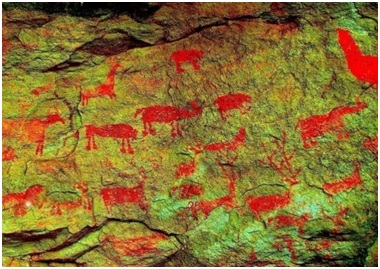
Ambadevi rock shelters
Prehistoric rock shelters with pictographs and petroglyphs
Deopahar
Explore this archaeological site.
Mirchpur
Explore this archaeological site.
Rajgadhi Timbo
Explore this archaeological site.
Thulukkarpatti
Explore this archaeological site.